

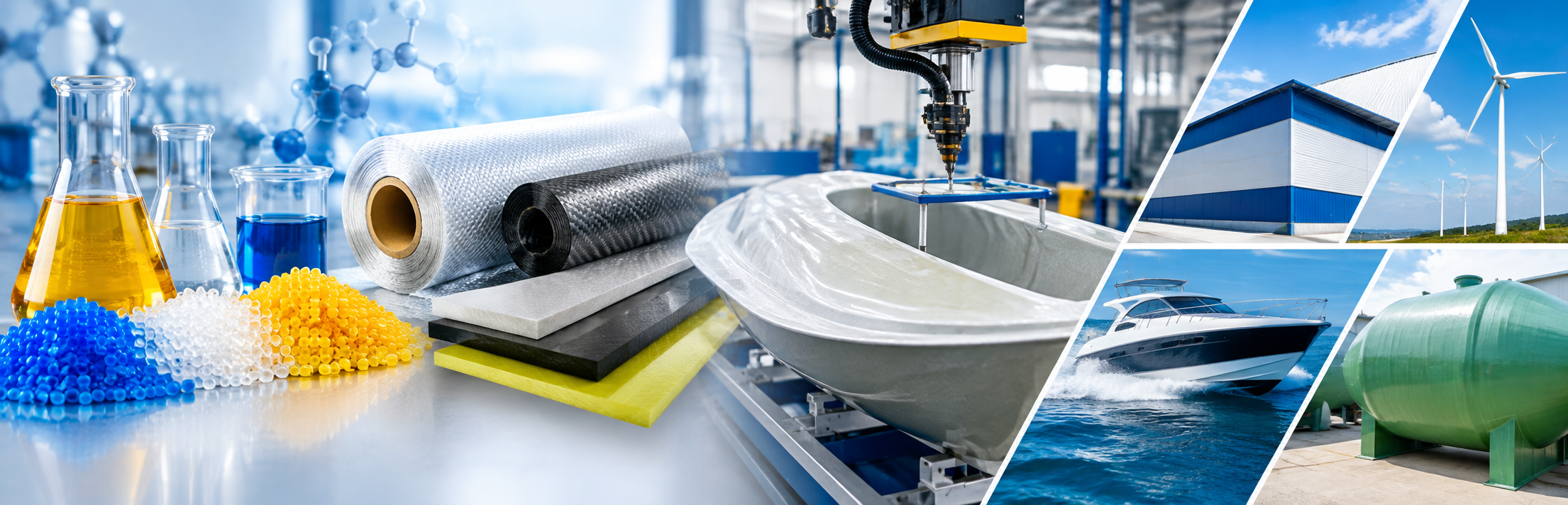
From Polymer Chemistry to Industrial Innovation: Building Materials for a Changing World
Industries around the world are continuously looking for materials that can deliver better performance, greater durability, improved efficiency, and greater design flexibility. As technology advances, traditional materials are increasingly being complemented by engineered polymers and composite materials designed for specific industrial requirements.
At Polymer Group of Industries, this transformation begins at the molecular level.
Our work brings together polymer chemistry, material science, manufacturing technology, composite engineering, and product development to create material solutions for a wide range of industrial applications. Rather than viewing polymers simply as raw materials, we see them as the foundation for developing products and technologies that can address the changing needs of modern manufacturing.
Where Chemistry Becomes Technology
Every advanced polymer product begins with a carefully developed chemical system.
The performance of a finished component can depend on numerous factors, including resin formulation, curing behavior, reinforcement selection, processing temperature, pressure, fiber orientation, and manufacturing conditions.
This connection between chemistry and engineering is at the heart of Polymer Group of Industries.
Our core strength lies in the manufacturing of thermoset polymeric resins, including Unsaturated Polyester Resins, Polyols, Phenolic Resins, Epoxy Resins, Vinyl Ester Resins, and Industrial Plasticisers.
Each material platform offers different characteristics and opportunities for industrial applications. By developing expertise across multiple resin technologies, we can approach material requirements from both a chemical and engineering perspective.
Designing Materials Around Applications
Modern manufacturing increasingly requires materials that are developed around a particular purpose rather than selected solely from a standard material category.
For example, a manufacturer may require a resin system with specific processing characteristics. Another application may require improved chemical resistance, thermal performance, mechanical strength, dimensional stability, or compatibility with a particular reinforcement.
This is where application-oriented polymer development becomes important.
Polymer Group of Industries focuses on understanding the relationship between material formulation and manufacturing requirements. This approach allows polymer technologies to be considered not only as chemical products but also as components of larger manufacturing systems.
The Transformation from Resin to Composite
One of the most important developments in advanced materials is the combination of polymer resins with reinforcing fibers.
When a suitable resin system is combined with materials such as glass fiber or carbon fiber, manufacturers can produce composites with properties that are different from those of the individual materials.
Composite manufacturing therefore requires an understanding of both the resin and the manufacturing process.
Polymer Group of Industries has developed a dedicated composite manufacturing vertical that allows the organization to work across this complete chain—from thermoset resin technology to finished composite manufacturing.
This integrated capability creates an environment where material knowledge can be translated into practical manufacturing solutions.
Multiple Manufacturing Routes, One Engineering Objective
Different products require different manufacturing technologies. Shape, volume, reinforcement architecture, production requirements, tooling, and performance specifications can all influence the selected process.
Polymer Group of Industries has capabilities covering several composite manufacturing technologies, including:
- Hand Lay-Up
- Hot Compression Molding
- Vacuum Resin Transfer Molding (VRTM)
- Prepreg Preparation
- Pultrusion
- Manual Lay-Up
Each process provides different opportunities for developing composite structures and components.
Hand Lay-Up
Hand lay-up offers flexibility for producing composite components in different shapes and sizes. It can be particularly useful for customized products, development work, prototypes, and applications where production flexibility is important.
Hot Compression Molding
Hot compression molding combines controlled heat and pressure to manufacture composite components. The process provides a controlled manufacturing environment and can support repeatable production of molded parts.
VRTM
Vacuum Resin Transfer Molding uses vacuum pressure to assist resin movement through reinforcing materials. Proper control of resin flow and fiber wet-out is important for producing consistent composite structures.
Prepreg Technology
Prepreg manufacturing involves combining reinforcement fibers with a controlled resin system before the final manufacturing stage.
This technology provides manufacturers with greater control over resin distribution and processing conditions and can be used for specialized composite applications.
Engineering Behind the Material
Advanced materials cannot reach their full potential without appropriate engineering infrastructure.
Tooling accuracy, mold design, machining, component preparation, and manufacturing control can all influence the final product.
Polymer Group of Industries has engineering and machining capabilities supporting its manufacturing activities. The infrastructure includes three vertical CNC machines, two turning centres, and multiple lathe and milling machines for mold preparation and engineering requirements.
This combination of chemical and mechanical expertise creates a connection between polymer development and physical product manufacturing.
Exploring the Potential of Carbon Fiber
The development of lightweight, high-performance materials has increased interest in carbon fiber composites across advanced engineering applications.
Carbon fiber can provide a combination of high strength, stiffness, and low weight, making it an important reinforcement material for specialized composite products.
Polymer Group of Industries has experience working with Carbon Fiber T-300 and epoxy resin systems for composite manufacturing.
A representative process involves preparing prepreg using epoxy resin under controlled temperature conditions, followed by hot compression molding using hydraulic pressure.
Such work demonstrates how material formulation, reinforcement technology, temperature, pressure, tooling, and processing must work together to produce an engineered composite component.
Research as a Manufacturing Advantage
Research and development is not limited to laboratories. In advanced manufacturing, research can continue throughout the entire production cycle.
A formulation may need to be evaluated during processing. A composite component may reveal opportunities for improving resin distribution. A manufacturing process may suggest changes to material formulation. Engineering requirements may lead to the development of a different polymer system.
This continuous exchange between chemistry, manufacturing, and engineering creates opportunities for improvement.
At Polymer Group of Industries, research and development supports the objective of developing practical solutions rather than focusing solely on theoretical material properties.
Building Manufacturing Knowledge
With a workforce of more than 200 employees, Polymer Group of Industries brings together expertise across different areas of industrial activity.
People remain an essential part of advanced manufacturing.
Chemical formulation requires technical knowledge. Production requires process discipline. Engineering requires precision. Composite manufacturing requires practical experience. Quality control requires attention to detail.
Bringing these disciplines together creates a broader manufacturing knowledge base that can support continuous improvement.
Materials for Diverse Industrial Requirements
The applications of polymer and composite technologies extend across numerous industries.
Thermoset resins and composite materials can contribute to construction products, infrastructure components, industrial equipment, transportation applications, electrical systems, corrosion-resistant structures, molded components, profiles, and specialized engineering products.
The suitability of a particular resin or composite system depends on the requirements of the final application.
For this reason, material selection should consider factors such as mechanical requirements, chemical exposure, temperature, processing method, environmental conditions, product geometry, and expected service life.
Polymer Group of Industries approaches these requirements through a combination of polymer expertise and manufacturing capabilities.
From Conventional Materials to Engineered Solutions
The future of industrial materials is increasingly moving toward engineering materials for specific purposes.
Instead of asking only, “Which material should we use?”, modern manufacturing often asks:
What performance should the material deliver, and how can we engineer the material and manufacturing process to achieve it?
This shift creates opportunities for polymers and composites.
Through controlled chemistry, reinforcement technologies, advanced processing, and engineering, materials can be designed around specific functional requirements.
Polymer Group of Industries is building its capabilities around this evolving approach.
Looking Ahead: The Future of Polymer Engineering
The next generation of industrial manufacturing will demand materials that combine performance with manufacturing efficiency and design flexibility.
Lightweight structures, advanced composites, corrosion-resistant components, specialized resins, and engineered polymer systems are expected to remain important areas of material development.
As manufacturing technologies evolve, the relationship between chemistry and engineering will become increasingly important.
Polymer Group of Industries aims to continue developing this relationship by expanding its capabilities in resin manufacturing, composite technologies, engineering, research, and application development.
Conclusion
Polymer Group of Industries is more than a manufacturer of polymer materials. Its capabilities connect chemistry, engineering, composite technology, and manufacturing to explore how advanced materials can contribute to modern industry.
From thermoset resin formulation to composite processing, from engineering machinery to specialized carbon fiber applications, the organization brings multiple disciplines together under one manufacturing platform.
The journey begins with polymer chemistry—but it does not end there.
It continues through research, engineering, processing, testing, manufacturing, and ultimately the development of materials designed to perform in the real world.
As industries continue to evolve, Polymer Group of Industries remains focused on one fundamental principle: turning polymer science into practical industrial possibilities.

Comments (2)
Hi, this is a comment.
To get started with moderating, editing, and deleting comments, please visit the Comments screen in the dashboard.
Commenter avatars come from Gravatar.
Hi, this is a comment.
To get started with moderating, editing, and deleting comments, please visit the Comments screen in the dashboard.
Commenter avatars come from Gravatar.